 Save
Save The winter solstice always stops me mid-breath—that moment when daylight seems almost extinct, when the kitchen feels smaller and cozier than usual. Last December, standing at my window with the afternoon already dark, I found myself thinking about balance, about how the darkest day still promises a return of light. That's when I imagined this board: one half rich and shadowed, the other luminous and fresh, like a visual promise that winter holds both mystery and brightness.
I tested this board on a gray Saturday afternoon with friends who were tired of the usual holiday formality. We stood around the kitchen island, reaching for walnuts and olives without ceremony, and someone said it looked like a storybook illustration come to life. No one sat down. We just kept gathering, kept talking, kept coming back for one more slice of pear. That's when I knew this wasn't just food—it was permission to linger.
Ingredients
- Kalamata olives: Buy them pitted if you can—it saves your hands and dignity, plus they stay intact on the board.
- Oil-cured black olives: These are the wrinkled, intense cousins; they taste nothing like canned olives, so don't skip them.
- Dried mission figs: Halving them shows off their jewel-like interior and makes them less overwhelming than whole ones.
- Fig jam: A small dollop becomes a flavor anchor—it bridges sweet and savory in the most elegant way.
- Dark chocolate: Broken into pieces rather than chopped; roughness matters here.
- Roasted almonds: The crunch and slight salt balance the sweetness of everything around them.
- Fresh rosemary: One sprig laid down as the dividing line doubles as both symbol and garnish.
- Ripe Brie cheese: Let it sit out for ten minutes so it's spreadable but still holds its shape.
- Ripe pears: Slice them just before assembling so they don't brown; a squeeze of lemon helps too.
- Honeycomb or honey: Honeycomb adds texture and wild beauty; honey is more practical if you're short on time.
- Toasted walnuts: If they're not already toasted, warm them in a dry pan for two minutes—it wakes them up completely.
- Seedless green grapes: Their simple brightness feels essential against all the richness.
- Fresh thyme: Scatter it on the light side like you're blessing the board.
- Baguette: Slice it the morning of; stale bread is your enemy here.
- Assorted crackers: Neutral ones work best so they don't compete with the other flavors.
Tired of Takeout? 🥡
Get 10 meals you can make faster than delivery arrives. Seriously.
One email. No spam. Unsubscribe anytime.
Instructions
- Claim your canvas:
- Find a board large enough to breathe—at least fourteen inches across. A wooden board or light marble looks stunning, but honestly, any flat surface works. Lay out that rosemary sprig or a row of crackers straight down the middle like a deliberate dividing line, almost ceremonial.
- Build the dark side:
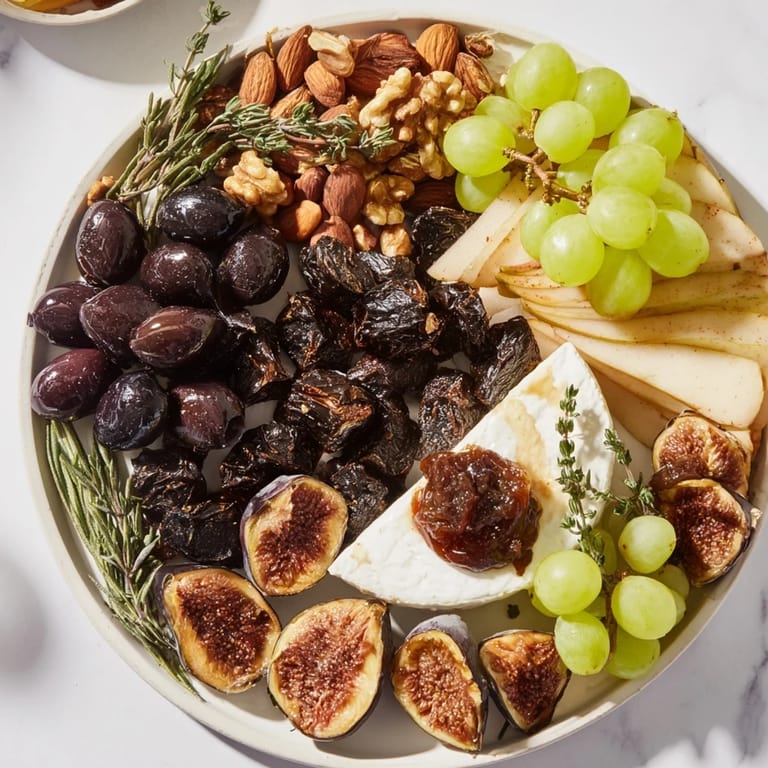
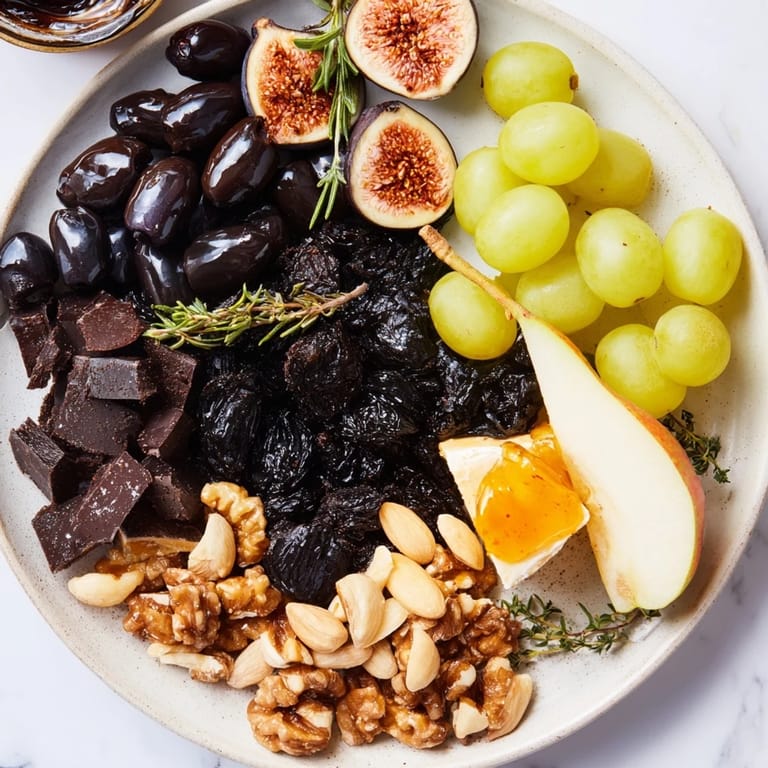
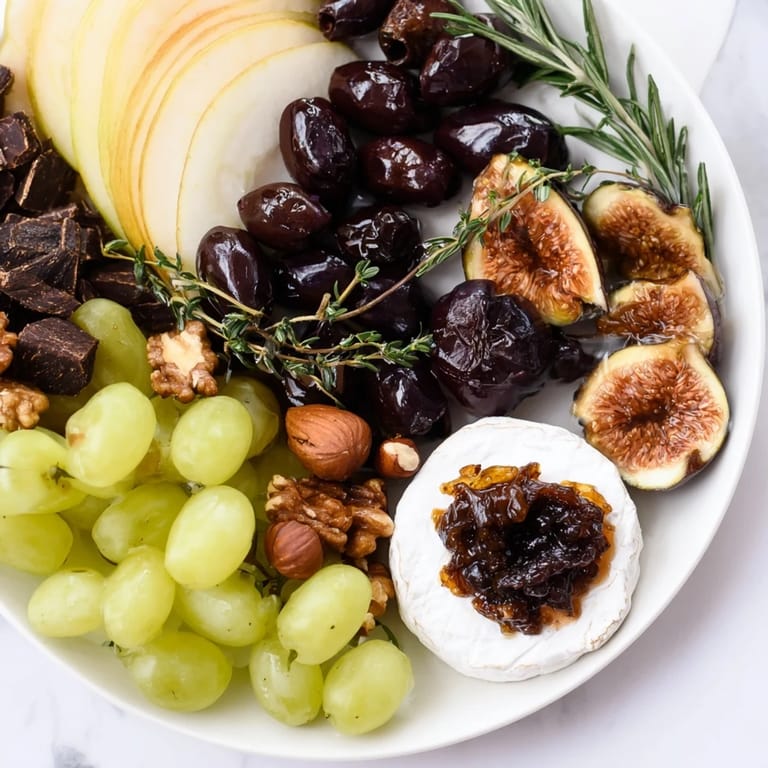
- Start with the olives in clusters, leaving small gaps between them—it's more inviting than a solid pile. Nestle the fig halves between them, revealing those burgundy interiors. Add the roasted almonds in a small drift, then place the dark chocolate pieces where they catch light. A small spoon of fig jam in one corner becomes a secret flavor destination.
- Illuminate the light side:
- Arrange the Brie as your anchor, whether as a wedge or a whole wheel—it's the generous centerpiece. Fan the pear slices slightly, overlapping like scales. If using honeycomb, position it near the Brie so they complement each other. Scatter walnuts and grapes with intention, not randomly.
- Finish with honor:
- Tuck fresh thyme sprigs around the light side the way you'd arrange flowers. Step back and look for empty spaces; fill them with intention. Put the baguette slices and crackers in a separate basket or along the center line so people can build their own bites.
- Serve at room temperature:
- This board is best when nothing is cold or fussy—pull it together about thirty minutes before guests arrive so all the flavors can settle into themselves.
 Save
Save My sister sat down with a small plate and this board one evening, and in ten minutes she'd created three different bite combinations, each more thoughtful than the last. She wasn't following instructions; she was having a conversation with the ingredients. That's when I realized a good board doesn't tell you what to eat—it invites you to listen to what you actually want.
The Symbolism of Contrast
There's something grounding about splitting a board into opposing halves. The dark side pulls inward—rich, intense, almost moody—while the light side opens outward, bright and immediate. It mirrors the solstice itself: the moment when darkness and light balance on a knife's edge. You don't have to believe in symbolism to feel it when you're arranging these elements. Your hands know what they're doing, even if your mind hasn't caught up.
Pairing and Accompaniments
This board doesn't demand wine, but it certainly welcomes it. A crisp, dry sparkling wine cuts through the richness of the Brie and chocolate without apology. A light-bodied red—nothing too heavy—echoes the earthiness of the figs and olives. Even a simple sparkling water with a slice of pear does something kind for your palate between bites. The board is forgiving; it pairs beautifully with almost anything poured into a glass.
Making It Your Own
The beauty of a board is how personally you can build it without losing its soul. Swap pears for apples if you want something tarter. Trade dried mission figs for dried apricots or cranberries if that feels right. Some people add prosciutto to the dark side for smoke and salt; some leave it strictly vegetarian. The two-sided structure stays the same, but the conversation between you and your ingredients changes every time. A board is less a recipe and more a starting point—a permission slip to create something that feels like yours alone.
- Prep everything the night before except pear slices, which oxidize quickly.
- Use a small ramekin for the fig jam so it doesn't spread everywhere.
- If you're serving outdoors in winter, keep the dark side slightly cooler and the light side slightly less cold—everything tastes better at micro-variations in temperature.
 Save
Save This board asks so little of you and gives so much back. It's a small rebellion against the feeling that winter requires constant effort and elaborate cooking.
Recipe Questions & Answers
- → How is the board divided to create balance?
Use a line of rosemary or crackers to split the board into two halves, one savory with olives and figs, the other fresh with Brie and pears.
- → Can any ingredients be substituted?
Yes, Brie can be swapped for Roquefort or Camembert; pears can be replaced with apples; dried apricots can replace figs.
- → What garnishes enhance the flavors?
Fresh rosemary on the dark side and thyme on the light side provide aromatic finishes and visual contrast.
- → Are there pairing suggestions for this board?
A dry sparkling wine or a light-bodied red wine pairs excellently with the mix of savory and fresh flavors.
- → How should the board be served?
Arrange at room temperature and serve immediately with sliced baguette and assorted crackers alongside.