 Save
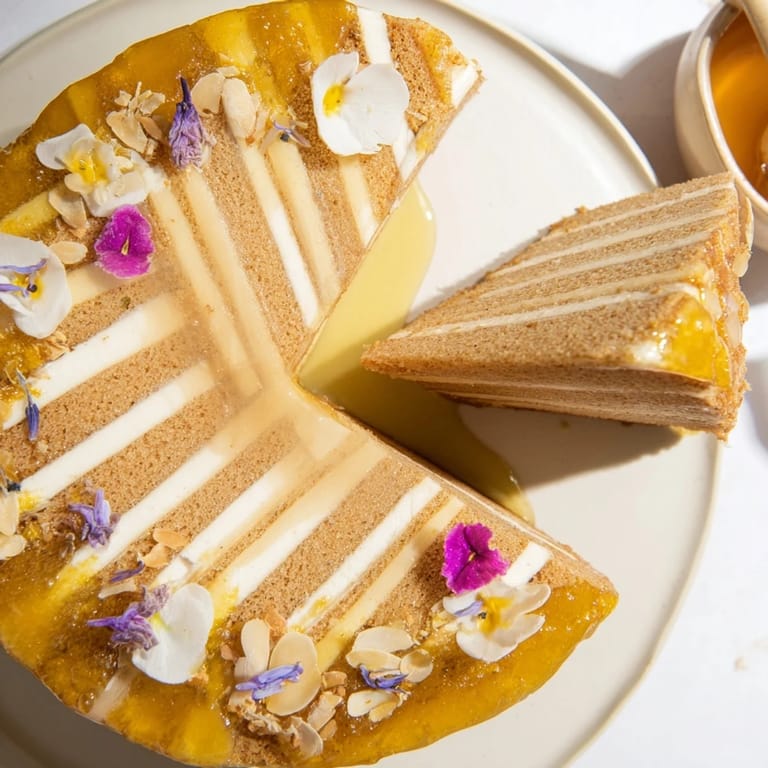
Save The first time I served this honey-drip cake, my friend reached for her fork and froze mid-motion when she spotted that golden pool in the center. There's something about honey that stops people—it catches light, it promises indulgence, and when you've built an entire dessert around it, the drama is irresistible. I'd been thinking about interactive desserts for weeks, sketching ideas on napkins between coffee sips, when it hit me: why not let honey be the star, not the supporting player? This cake emerged from that daydream, and now I can't imagine serving it any other way.
I made this for a dinner party on a September evening when the light was turning golden and everyone seemed to need a little magic. My sister watched from the kitchen counter, skeptical about the whole "honey pot in the middle" concept until she saw the finished cake under the soft glow of candlelight. When the first guest cut into it and saw that honey start to ooze, the table went quiet for just a second. Then everyone laughed, and suddenly we weren't just eating dessert—we were sharing something memorable together.
Ingredients
- All-purpose flour: Two cups gives you the tender crumb you want without the heaviness of too much structure, leaving room for the honey's moisture to shine.
- Baking powder and baking soda: This pairing lifts the cake gently; the combination ensures it stays cloud-like despite all that liquid sweetness.
- Unsalted butter: Half a cup is your foundation for richness, and unsalted lets the honey flavor take center stage without competition.
- Granulated sugar and honey: Together they create a tender crumb and a subtle complexity that plain sugar alone never achieves.
- Large eggs: Three of them bind everything and add moisture, which this honey-forward cake absolutely needs.
- Whole milk: Three-quarters cup keeps the batter silky and helps distribute the honey evenly throughout.
- Heavy cream and mascarpone: This filling is your secret weapon—it's tangy enough to cut through honey's richness and creamy enough to stick layers together gracefully.
- High-quality liquid honey: One full cup for serving is non-negotiable; it's the entire point, so buy the best you can find.
- Toasted almonds: Quarter cup chopped and toasted adds texture and a whisper of earthiness that balances all that sweetness.
Tired of Takeout? 🥡
Get 10 meals you can make faster than delivery arrives. Seriously.
One email. No spam. Unsubscribe anytime.
Instructions
- Set the stage:
- Preheat your oven to 350°F and grease those cake pans with real butter, not spray—it gives you better browning on the edges. Line the bottoms with parchment so your layers come out clean and confident.
- Build your dry team:
- Whisk flour, baking powder, baking soda, and salt together in one bowl; this distributes the leavening evenly so you won't get any dense pockets later.
- Cream until fluffy:
- Beat softened butter and sugar for at least two minutes until the mixture goes pale and light—this isn't just mixing, it's incorporating air that makes the cake tender.
- Marry the wet ingredients:
- Add honey, then eggs one at a time, then vanilla to your butter mixture, beating well after each addition so everything emulsifies smoothly and beautifully.
- Alternate like a rhythm:
- Add your dry ingredients and milk in three additions, starting and ending with dry, folding gently between each addition to avoid overdeveloping the gluten. This is where patience pays off.
- Bake with confidence:
- Divide batter evenly between pans and bake 22 to 25 minutes until a toothpick comes out clean and the top springs back gently when touched. Cool completely before moving forward.
- Whip your cream filling:
- Whip heavy cream to soft peaks, then fold in honey and mascarpone and whip to stiff peaks—this filling should be cloud-like and hold its shape.
- Layer like you mean it:
- Slice each cooled cake horizontally into two thin layers, then stack them with honey cream between each layer, pressing gently so everything bonds without squishing.
- Cut the honey hole:
- Use a 3-inch round cutter to carefully bore through the center of your entire stacked cake, wiggling gently to avoid crumbling the layers. This takes a steady hand and a little faith.
- Set the honey pot:
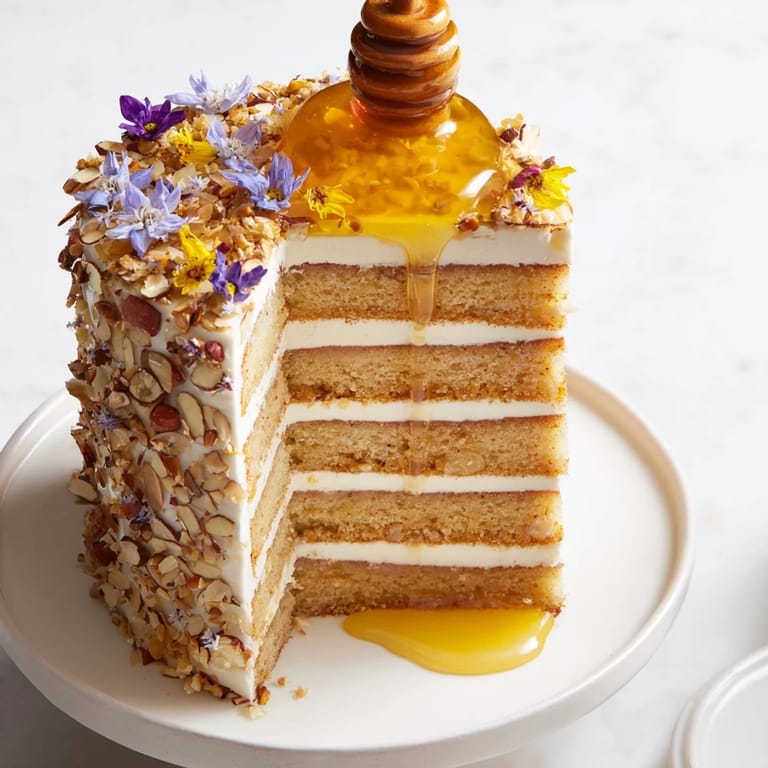
- Nestle a small glass or ceramic honey pot into the hole and fill it with your best liquid honey—this is the moment everything transforms into something unforgettable.
- Garnish with intention:
- Scatter toasted almonds across the top, add edible flowers if you have them, and drizzle honey around the edges for that extra golden glow.
 Save
Save There's a moment right before someone cuts into this cake when they pause, fork hovering, taking in the golden honey pooling in the center. I live for that moment—it's when dessert becomes something more than sustenance, something worth remembering. It's become my go-to for when I want to cook something that makes people feel a little more special than they did when they arrived.
Choosing Your Honey Wisely
Not all honey is created equal, and for this dessert, quality matters more than it might for other recipes. Wildflower honey brings a complex floral undertone that feels sophisticated, while acacia honey is milder and smoother for those who prefer subtlety. I've also experimented with orange blossom and lavender honey, and each one tells a different story—orange blossom gives an almost perfumed elegance, while lavender honey adds an unexpected herbal whisper that surprised everyone at my table. Go to a farmers market if you can and taste before you buy; you might discover your new favorite.
The Art of Slicing and Serving
This dessert works best when served at room temperature, when the honey flows but the cake still holds its shape. I use a long serrated knife dipped in hot water and wiped clean between each cut—it prevents the layers from compressing and keeps everything looking beautiful on the plate. The ritual of dipping each forkful into that warm honey at the center is half the experience, so encourage your guests to play with it, to make a little mess, to enjoy the interactive nature of something so intentionally designed for sharing.
Pairing and Presentation
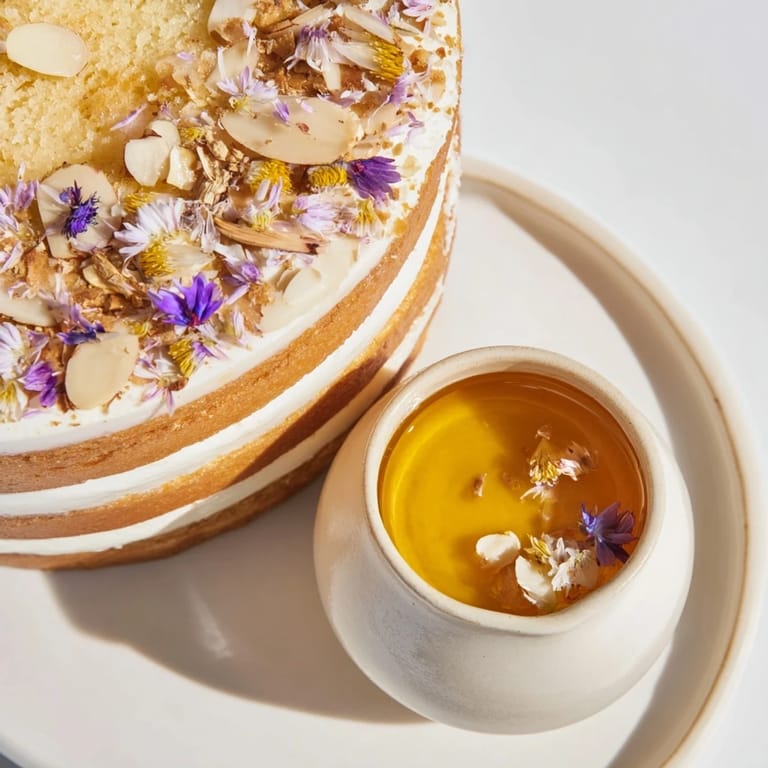
I've served this with Moscato and late-harvest Riesling, and both are transcendent pairings—the wine's sweetness echoes the honey without fighting it, and the acidity cuts through the richness like a gentle reminder that balance exists. For non-wine drinkers, chamomile tea works beautifully, or even sparkling water with a splash of honey and lemon. Presentation matters here too; I always set the cake on a pedestal or cake stand if I have one, letting the honey pot catch the light from the table candles. It transforms a dessert into a centerpiece, a conversation starter, a moment.
- Serve this at dinner parties or special occasions where the presentation is half the gift.
- Make sure your honey pot is heatproof ceramic or glass so the honey stays warm throughout the meal.
- Have extra napkins nearby—honey dripping is part of the charm, but also part of the mess.
 Save
Save This honey-drip cake has become my answer to the question of what to make when I want something unforgettable. It's proof that the simplest ideas—letting one ingredient shine, turning dessert into an experience—can create the most meaningful moments around a table.
Recipe Questions & Answers
- → What kind of honey works best for this dessert?
Wildflower or acacia honey with rich floral notes enhances the cake’s sweetness and aroma, but orange blossom or lavender honey can add unique flavors.
- → Can the honey cream filling be prepared in advance?
Yes, the honey cream filling can be made ahead and chilled until ready to assemble, helping the flavors meld beautifully.
- → How can I make this dessert nut-free?
Simply omit the toasted almonds garnish to accommodate nut allergies without compromising the overall flavor.
- → What tools are essential for shaping the cake?
An 8-inch round cake pan for baking, and a 3-inch round cutter to create the central cavity for the honey pot are key tools.
- → How should guests enjoy this dessert?
Guests slice portions of the layered cake and dip each bite into the warm honey pot, enhancing each mouthful with liquid honey.